
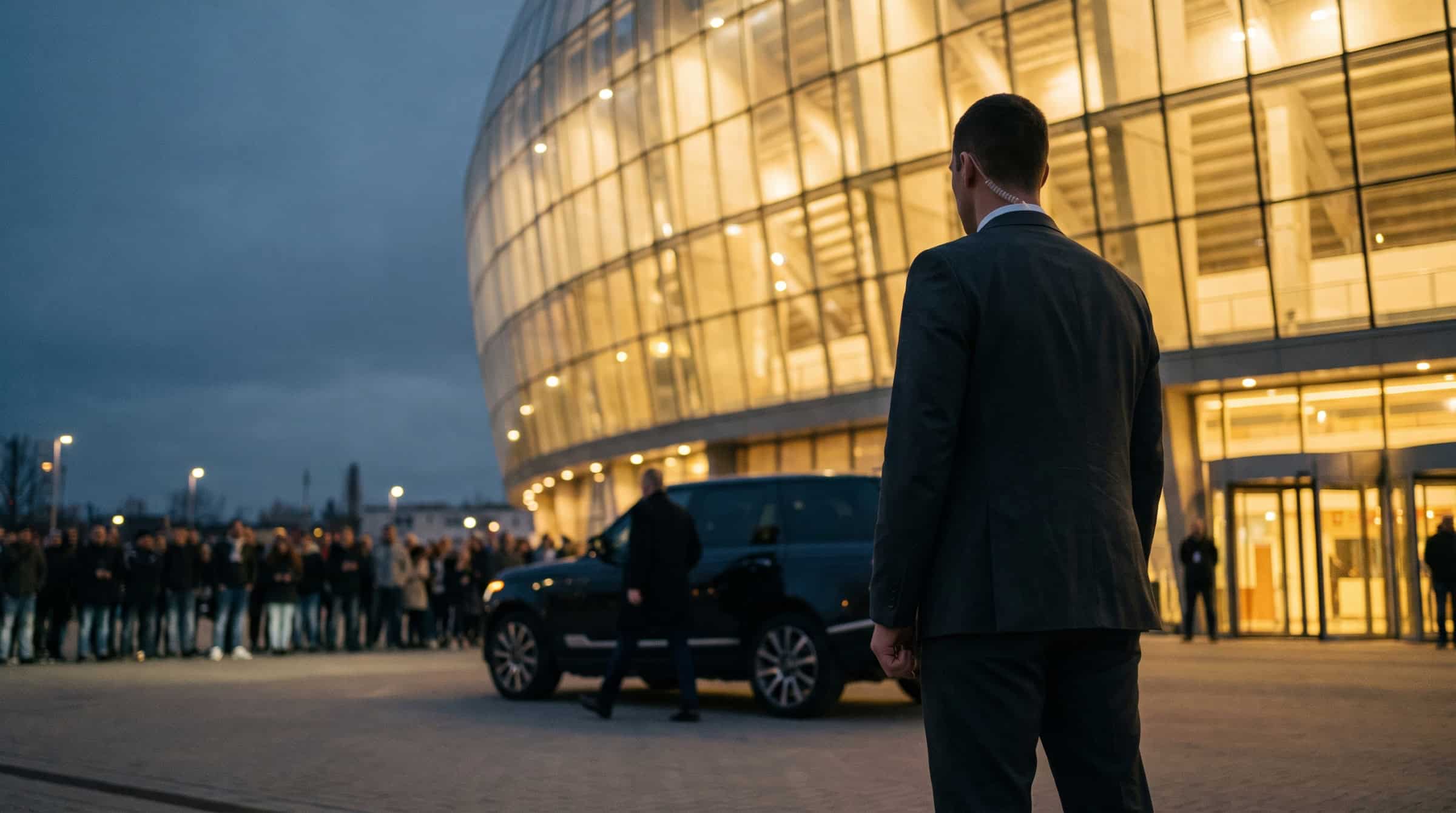
The World Cup has concluded, and with it the largest concentration of high-profile guests that any sporting event produces. Heads of state in the presidential box, executives in corporate hospitality, owners, investors and public figures through the stands; all of them inside a security operation of real scale, and almost none of them protected by it in any personal sense.
The same distinction holds at every consequential event: a final, a summit, an awards ceremony, a Grand Prix. The security operation at a major event is built for the event. It is not built for the individual.
Two things follow. First, a personal protection team at a major event operates within someone else’s security plan, alongside other teams with different principals. Second, the work required to operate in that environment cannot be compressed into the final week. This article addresses both.
Event security exists to protect the event: the crowd as a whole, the venue, the fixture, and the event’s ability to proceed. Its instruments are perimeter control, screening, stewarding, crowd management and emergency planning at scale. At a well-run event, most of it is done well.
None of it constitutes a protective plan for any individual guest. Screening at the gate keeps prohibited items out of the venue; it does not manage the approach of a specific person with a specific profile. Stewards move crowds; they are not trained to recognise the early indicators of a threat directed at one guest among eighty thousand.
The medical plan is dimensioned for the crowd. It makes no provision for a principal with a known condition, a preferred hospital or an insurer’s evacuation requirements. If an incident forces the venue to evacuate, the event’s plan moves the crowd – and the principal moves with it, in whatever direction the crowd is moving.
For an executive attending through corporate hospitality, the gap is wider still. Responsibility for the visit is divided between the sponsor who issued the invitation, the hospitality operator delivering the package, the event’s security contractors and the venue team. Each holds a piece; none is accountable for the guest’s personal security. The itinerary has been arranged. It has not been protected.
Practical steps for corporate security managers bridge this gap. Early engagement is essential: initiate contact with all relevant parties – the sponsor, hospitality provider, venue security and event organisers – as soon as an invitation is confirmed. Clarify roles and responsibilities, and request details of access procedures, emergency protocols, and any planned movement schedules. Ensure your team is accredited before deadlines, and build in time for venue reconnaissance and travel route planning. By proactively coordinating with stakeholders and setting clear expectations before the event, managers can transform a passive visit into a protected one.
What distinguishes major events from other close protection tasks is not only the scale of the crowd. It is the number of other security operations running inside the same footprint at the same time. At a World Cup final or a comparable occasion, three tiers of protection operate simultaneously, each with its own principal, its own authority and its own priorities.
The event’s security structure. The organising body, the venue and their contracted providers, usually under the direction or oversight of the host nation’s police. This tier controls the ground: accreditation, vehicle access, screening lanes, restricted zones and the emergency plan. Every other team at the event works within the rules this tier sets, whether or not they have coordinated with them.
Private protection teams attending with their own principals. Dozens of them at a major final, protecting owners, sponsors’ guests, entertainers, executives and family offices. Each team answers only to its own client, and each wants the same things at the same moments: the drop-off point closest to the entrance, a clean route through the concourse, a holding position with sightlines, an unobstructed departure. These teams are not adversaries. Without prior liaison, they are competing users of the same choke points.
Effective liaison best practices can prevent this operational friction. As a first step, security managers should establish contact with other teams and the event security lead well before the event, using formal introductions and sharing relevant contact details. Agreeing on basic schedules, identification protocols, and primary points of contact for each team is essential. Where possible, participate in joint briefings or distribute a liaison notice that outlines team locations, movements, and responsibilities. By clarifying intentions and maintaining open communication channels, managers can foster cooperation, prevent misunderstandings, and ensure smoother coordination in complex environments.
Government protection details. Where heads of state, ministers, or royalty attend, state teams operate under legal authorities that no private team holds, including, in most jurisdictions, the carriage of firearms, and with priority over everyone else’s arrangements. Their road movements close routes at short notice. When a state detail moves its principal, corridors clear, lifts are held, and vehicle circuits pause, regardless of the effect on anyone else’s timings.
Operating among these tiers presents four recurring difficulties, and these are the substance of the advance work.
Deconfliction – Arrival and departure windows, drop-off points and internal routes are agreed with the venue in advance and, where possible, sequenced around other known movements. The alternative is a queue of protected vehicles at a single checkpoint minutes before kick-off.
Primacy and accreditation – Inside the venue, the event’s security structure and the police hold authority. A team that has not established its status in advance – who its operators are, what accreditation they carry, where they are permitted to stand – has that status decided for it at the door, in front of the principal. Accreditation for major events closes weeks ahead. It cannot be arranged on the day.
Communications and recognition – Multiple teams on separate radio channels, unknown to one another, in a crowd is an environment where mistakes happen. An operator moving quickly towards his own principal looks, to a team that has never seen him, like the very thing they are watching for. Prior liaison – introductions, descriptions, an agreed point of contact in the venue control room – replaces that friction with a working relationship.
Jurisdiction – Licensing regimes differ by country. What a UK-licensed operator may do at Wembley is not what the same operator may do in another host nation, and the rules governing private security at a state-attended event differ again. An operation that has not resolved these questions before travel is not a protective operation.
None of this work is unusual. It is the ordinary content of an event advance: venue reconnaissance, liaison with the event’s security management, accreditation, route planning around closures, and contingencies that hold in the relevant jurisdiction.
Short-notice requests are a fixture of event protection, and the reasons are structural. Hospitality invitations are confirmed late. A tentative appearance becomes a definite one when the home side reaches the final. A corporate security manager learns on Wednesday that the chief executive has accepted a sponsor’s box for Saturday.
A significant proportion of enquiries around any major event arrive inside the final week. Each element of the advance work degrades predictably as notice shortens.
Reconnaissance – A team that has not walked the venue, the approach, and the alternatives, and works from plans and photographs, and discovers the differences in real time with the principal present. The remaining risk is that small changes in access, timing or circulation are only revealed when it is already difficult to adjust.
Accreditation – Often unavailable at short notice, which can leave operators restricted to public areas – separated from the principal at the points where proximity matters. The remaining risk is delay at the door, where a team can be held or turned back before it reaches the principal.
Transport – Vehicles arranged in a hurry mean unvetted cars and unfamiliar drivers on roads that will be closed and re-routed for the event. The remaining risk is that a hurried vehicle plan creates uncertainty at exactly the moment movement needs to be controlled.
Medical and evacuation contingencies – These collapse to whatever the event provides for the general crowd. The remaining risk is that a principal with specific needs will be moved by a plan that was never built for them.
Team selection – The pool narrows to the available operatives rather than to those best matched to the principal, the task, venue, and the jurisdiction. The remaining risk is a team that is present but not ideally suited to the environment.
There is a further risk, and it is the least visible. A detail assembled at short notice can appear protective without the planning that gives the presence meaning. The principal believes the visit has been protected. It has been accompanied. The remaining risk is false confidence: the appearance of coverage without the substance of protection.
Short-notice work can be done responsibly. An established security company has teams of screened and vetted operatives, reliable transport and long-standing venue relationships precisely so that a compressed timeline yields a reduced plan rather than no plan. When selecting a provider for a short-notice task, look for key attributes: demonstrated experience with similar events, strong local contacts, transparent communication about limitations, and a clear track record of compliance with relevant accreditation and jurisdictional requirements. The provider should be able to state exactly which elements are in place, which have been abbreviated, and what that means for the visit. Twenty-four hours’ notice does not produce the result of four weeks’ planning. The remaining risks should be set out plainly: reduced familiarity, narrower options, and less room to recover when something changes.
Each of the difficulties described here is soluble, but none is soluble quickly.
The gap between event security and personal security is closed by an individual protection plan. The layering of teams is managed through liaison and deconfliction. Accreditation is secured before the deadline, not after it. Jurisdictional questions are answered before travel.
If an event is already in the diary for the season ahead – a final, a conference, an awards evening, a race weekend – the protective arrangements belong in the diary with it. The tournament has concluded. The pattern it illustrated will recur at the next event of scale, and the lead time will still matter.
For effective advance planning, security managers should follow a clear sequence:
1. Confirm event details and invitation status as early as possible.
2. Identify all relevant stakeholders and initiate early contact with event organisers, sponsors, hospitality operators, and venue security managers.
3. Request and review access procedures, accreditation requirements, venue plans and procedures.
4. Submit accreditation applications ahead of deadlines and verify documentation for all team members.
5. Conduct reconnaissance of the venue, approach routes, and local environment, either in person or through trusted contacts.
6. Establish liaison with other protection teams and the event security management, agreeing on roles, contact protocols, and deconfliction measures.
7. Plan transport with local vetted drivers familiar with the event restrictions and road closures – this will be your biggest problem that you can least control.
8. Ensure medical provisions and evacuation contingencies are tailored to the principal, including local contacts and hospital preferences.
9. Brief the principal on the security plan, outlining procedures for arrivals, departures, and contingencies.
A systematic approach ensures that the protective plan is not left to chance and is integrated into the event timeline.
Westminster Security provides close protection, secure transport, and event security for principals, family offices, and corporate security teams, from its London base to events internationally.