
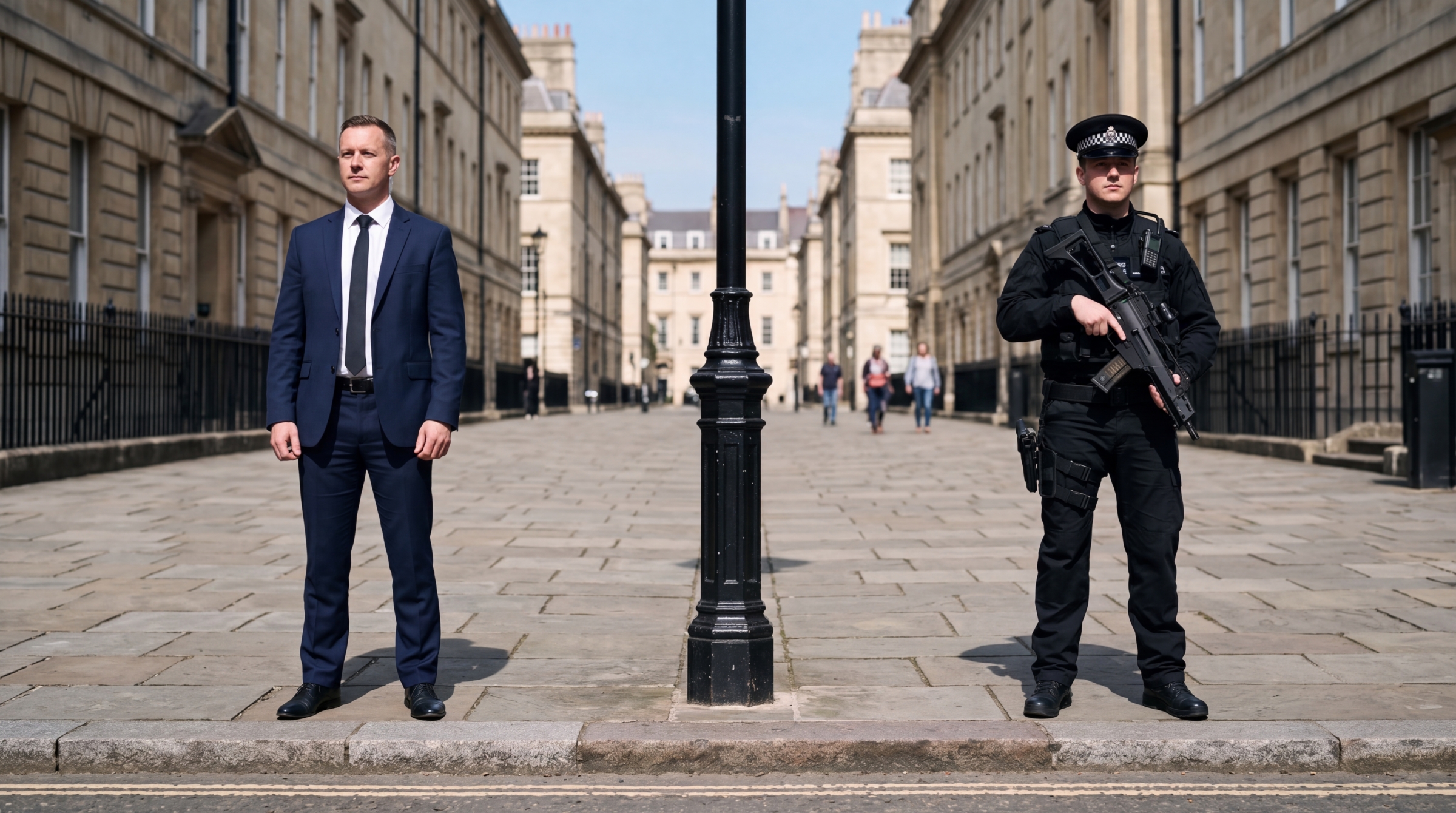
For most of the past century, the answer to this question has been so obvious that nobody bothered to ask it; should bodyguards be armed in the UK? Private bodyguards in the United Kingdom are not armed. They cannot be armed. The law does not permit it, the public would not accept it, and the industry itself has never seriously demanded it. We have said as much on our own website for years: a bodyguard who believes they can carry weapons in the UK has already failed.
And yet, in the space of a few short weeks, the question has stopped being rhetorical.
The killing of Ann Widdecombe at her Devon home in July 2026 has forced the security of public figures back to the top of the national agenda. This is barely five years after Sir David Amess was stabbed to death at a constituency surgery, and a decade after Jo Cox was shot and stabbed in the street in Birstall. The Home Secretary told the Commons that the case “raises questions about the security of those in public life.” Senior politicians across the spectrum have called for a serious review of how we protect the people we elect.
Days later, LBC published a piece asking why the protection of British politicians is so inconsistent. Why armed specialists may surround a cabinet minister but, at the same time, a backbencher who has received death threats gets a panic button and a phone number. That article did something almost unheard of in mainstream coverage of this industry: it looked honestly at what private close protection operatives in the UK are actually trained to do, what they are legally permitted to do, and the gulf between the two. It went further still, arguing for an enhanced tier of licensing under which vetted, experienced operatives could carry Tasers; and, in some cases, firearms.
That is a remarkable thing to see in print in Britain. And it means the conversation has started, whether the industry is ready for it or not.
So let us have it properly. Should bodyguards in the UK be armed? What follows is not a manifesto for either side. It is an honest account of how protection in this country actually works, what the law really says, the strongest case for change, the strongest case against it, and what would have to happen before anything changed at all.
The United Kingdom already operates what is, in effect, a two-tier system of personal protection. It is just that few people outside the industry ever look at it directly.
At the top sits the state. Armed personal protection for the Royal Family, the Prime Minister, former Prime Ministers, senior ministers and certain other public figures is delivered by the Metropolitan Police’s Royalty and Specialist Protection command (RaSP): career police officers, selected after years of exemplary service, trained in firearms, protection craft and advanced driving, with secure communications and direct access to the intelligence picture. Who receives this protection is decided not by the individual but by RAVEC, the Home Office-chaired committee that assesses risk to royalty and public figures. Its decisions are not for sale: as the Duke of Sussex discovered through years of litigation, you cannot simply buy police protection in this country, however wealthy you are. The Court of Appeal upheld RAVEC’s approach as recently as May 2025.
Below that tier sit everyone else and a patchwork of measures that has largely grown up in response to tragedy. After Jo Cox’s murder in 2016, annual spending on MPs’ security rose from roughly £171,000 a year to over £4 million within two years, and Operation Bridger gave every MP a named police contact. After Sir David Amess was killed in 2021, every MP was contacted by their chief constable and security operatives began attending constituency surgeries. In February 2024, the government announced a £31 million package for the security of elected representatives. Significantly, this included private-sector close protection for those facing elevated risk. During the 2024 general election, the Home Office-funded Operation REGENCY put private security alongside more than 200 candidates at over 500 events. It has since been recommended that this become the default at future elections.
Note what has quietly happened here. The British state, which will not arm a private operative under any circumstances, has already become the largest customer of unarmed private close protection in the UK for its own politicians. Taxpayer-funded private bodyguards and secure transport have been provided to high-risk backbench MPs. The precedent that private operatives are fit to protect elected representatives has not merely been set; it is now written into government policy.
The scale of the underlying threat explains why. The Speaker’s Conference on the security of MPs reported in 2025 that 96 per cent of MPs surveyed had experienced threatening behaviour or communications; roughly half reported anxiety or depression as a result, and one in three had considered standing down. More than half of candidates at the 2024 general election experienced intimidation or abuse. This is the environment in which four attacks on parliamentarians in a generation- Nigel Jones and his aide Andrew Pennington in 2000, Stephen Timms in 2010, Jo Cox in 2016, Sir David Amess in 2021 – have now been joined by the death of a former minister in 2026.
Meanwhile, the police service at the top of the protective pyramid is under strain. Officer numbers in England and Wales are falling again – down to around 145,500 by late 2025, the first sustained decline since the uplift programme ended. The number of operationally deployable authorised firearms officers, at around 5,900, remains roughly 700 below its 2019 peak, despite a modest recovery in the latest figures. And the weakness of the armed policing model was exposed in the autumn of 2023, when, after a Metropolitan Police marksman was charged with murder over the shooting of Chris Kaba, around 300 of the Met’s armed officers handed in their firearms authorisations in a matter of days and the Army was placed on standby to backfill counter-terrorism cover. The officer, Sergeant Martyn Blake, was acquitted at trial. The episode nonetheless demonstrated something the protection world already knew: Britain’s armed capability is a thin crust, and it can crack.
Private security, by contrast, is not thin. There are now over half a million active SIA licences in the United Kingdom – around 446,000 individual licence holders, of whom roughly 12,000 hold a close protection licence. Licensed private security personnel now outnumber police officers in England and Wales by roughly three to one. The industry patrols shopping districts, protects critical infrastructure, guards court buildings, and, through ventures such as council-commissioned warden schemes, increasingly walks beats the police have vacated. Under Martyn’s Law, the SIA itself is about to take on the largest protective-security remit in its history, regulating counter-terrorism preparedness at hundreds of thousands of venues from 2027.
The direction of travel is not in doubt. The private sector is doing more of Britain’s protective work every year. The question is where that road ends and whether, at some point along it, the state permits a small number of private protection operatives to carry the tools it currently reserves for its own.
Start with an awkward truth about the baseline. The licence-linked qualification for a close protection operative in the UK is a Level 3 certificate requiring a minimum of 194 guided learning hours, around 18 days of training, for £1,500 to £3,000, plus a three-day first-aid qualification. That is the legal minimum standard to stand next to a principal whose life may be under threat.
Eighteen days. By comparison, the Royal Military Police Close Protection Unit course, which trains soldiers to protect British military officers, visiting royalty, ministers and diplomats in hostile environments overseas, runs for eight intensive weeks, and is open only to select serving personnel of a certain rank who already have 3 months basic military training and an additional 6 months specialist service police training behind them. Police protection officers in RaSP undergo months of specialist training in addition to their policing careers. The gulf between the state’s standard and the industry’s minimum standard is not a gap; it is a canyon.
To be clear, the minimum is not the market. Leading providers in the industry set far higher standards in recruitment and training: reputable firms recruit almost exclusively from ex-military and ex-police backgrounds, deliver training well beyond the licence requirement, and would not put a newly qualified eighteen-day operative anywhere near a CP task. Many also operate internal quality assurance regimes, developing a culture in which excellence is expected rather than merely compliance. The SIA itself knows the baseline is too low: it introduced mandatory top-up training in 2022, added a compulsory refresher qualification from 2026, and in November 2025 launched a root-and-branch review of licence-linked qualifications, explicitly including close protection “depth requirements,” with new standards expected to become mandatory in spring 2027. Professionals and industry associations are well positioned to advocate raising the minimum bar by sharing expertise, supporting reform, and encouraging regulators to formalise what responsible firms already consider standard practice. But none of that changes the fact that today, the licence in an operative’s pocket guarantees only that legal minimum. As the LBC piece put it, “minimum is doing a lot of work in that sentence.”
Now consider what that operative, however well trained, is actually permitted to do and carry.
They have no police powers. None. An SIA licence is a permission to work, not a grant of authority. A close protection operative’s legal toolkit is exactly that of any other citizen: the “any person” arrest power under section 24A of the Police and Criminal Evidence Act 1984, which applies only to indictable offences and only where it is not reasonably practicable for a constable to make the arrest; and the right to use reasonable force in self-defence or the prevention of crime under common law and section 3 of the Criminal Law Act 1967.
They carry no defensive equipment beyond body armour, which is lawful only because Parliament has never regulated it. Everything else is closed off by statute:
A firearm is out of the question. Handguns have been prohibited weapons since the post-Dunblane legislation. In Great Britain, successive governments have maintained the position that personal protection is not a “good reason” for the grant of any firearm certificate. Pepper spray and CS spray are classed as prohibited weapons under section 5(1)(b) of the Firearms Act 1968. Legally, a canister of pepper spray is a firearm, and possession carries up to ten years’ imprisonment. Stun guns and Tasers are likewise prohibited; a stun gun disguised as another object attracts a mandatory minimum sentence of five years. Even the humble baton is a criminal offence twice over: an offensive weapon per se under the Prevention of Crime Act 1953 if carried in public, and an article whose very sale and importation is banned under section 141 of the Criminal Justice Act 1988.
This is the reality behind every glossy image of British “bodyguards”. The professional standing beside a principal outside a London hotel is protected by training, planning, positioning and judgement, and by absolutely nothing else. If an attacker produces a knife, the operative’s options are their hands, their body, a nearby item as an improvised defensive weapon, and their willingness to put both between the threat and the principal. Andrew Pennington, who died doing exactly that in 2000 and was awarded the George Medal for it, is the starkest illustration of what “unarmed protection” ultimately means.
Whether that is a proud feature of British life or an indefensible anomaly is precisely the argument now beginning.
The argument for change does not begin with guns. It begins with arithmetic.
The state cannot protect everyone it acknowledges to be at risk. RAVEC protection extends to a small circle. Operation Bridger provides liaison, not bodyguards. The armed policing capability that underwrites the whole system is hundreds of officers below its peak, subject to the kind of collective withdrawal seen in 2023, and inconsistently applied across 43 forces, as the Speaker’s Conference found. The state’s own answer to this shortfall, on the record since February 2024, has been to hire private close protection for at-risk politicians. It is reported that the leader of one of Britain’s largest parties is today protected on a day-to-day basis by a privately funded close protection team. The demand for protection has outgrown the state’s capacity to supply it. That is not an opinion; it is now the operating assumption of government policy.
The advocates’ next point is that the absolute prohibition on private firearms is less absolute than the public believes. Since 2011, the Home Secretary has issued section 5 authorisations to private maritime security companies so that their contractors can carry rifles aboard UK-flagged ships transiting High Risk Areas; a regime mature enough to occupy its own chapter of the Home Office’s firearms licensing guidance and its own general trade control licence. In Northern Ireland, uniquely, personal protection is an accepted reason to hold a firearm, and individuals under verified threat may be granted Personal Protection Weapons. And where British interests require armed protection abroad, the government does not hesitate to contract it privately: in 2024 the Foreign Office awarded a £17.6 million contract for armed mobile and residential security teams at the British Embassy in Tripoli. The British state, in other words, already authorises, regulates and purchases armed private protection – everywhere except on the British mainland.
Nor is Britain’s blanket ban the only model available in a comparable democracy. France, after the 2015-16 terror attacks, amended its law so that from 2018 a licensed agent de protection rapprochée may carry a pistol where the principal faces exceptional risk to life, under case-by-case ministerial authorisation. Germany’s Weapons Act allows licensed security firms to arm vetted personnel for specific assignments, including the protection of a demonstrably endangered person, with mandatory liability insurance. The United States regulates armed protection at state level as a matter of routine. These are not lawless jurisdictions; they are neighbours and allies who concluded that a narrow, tightly authorised exception was compatible with public safety.
From there, the proposal writes itself, and it is the one sketched in the LBC article: a tiered SIA licence. This would not amount to a relaxation for the industry but a raising of the bar so steep that almost nobody clears it. The overwhelming majority of the 12,000 close protection licence holders would see no change. Above them would sit an enhanced tier defined by background (ex-armed police, ex-RaSP, ex-military close protection), enhanced vetting of the kind government contractors already undergo, continuous training and requalification to police standards, psychological assessment, and direct liaison with police intelligence. Any equipment authority would be incremental and grudging: possibly starting with less-lethal options such as irritant spray, baton, or possibly Taser for defined tasks, with firearms conceivable only for a final, vanishingly small cohort protecting principals under verified threat-to-life, on specific authorisation, in the way the maritime regime already operates.
For professionals in the industry, the preparatory steps begin now. Those who aspire to play a role in any future enhanced tier should actively seek out advanced, recognised training that goes well beyond the statutory minimum, pursue ongoing professional development, and aim to build a track record of work in high-trust, high-accountability environments. This can include joining a military Reserves unit, volunteering as a police special constable, enrolling in specialist security management courses or advanced close protection related training. Membership in professional bodies such as the Security Institute offers access to continuing education, mentorship, and sector briefings. Engaging with the current SIA consultation on licensing reform and participating in working groups or consultation sessions facilitated by the SIA provides a concrete pathway into shaping the future regulatory landscape. Supporting higher professional standards through these associations and contributing to policy discussions within industry bodies, for example by joining an SIA special interest group, will help shape the direction of future regulation. In this way, practitioners can position themselves and the wider industry as credible partners, ready for whatever changes lie ahead.
For those seeking immediate action points, there are practical steps that can be taken this year to prepare for possible regulatory changes:
The SIA is currently rebuilding its qualification structure for 2027, and the government has spent two years describing private security as part of an “ecosystem of public protection.” The scaffolding for a tiered system, advocates argue, is already being erected; the only question is how high it will eventually reach. Five years ago the suggestion that private operatives should protect MPs was dismissed out of hand, including by some of the loudest voices in parliamentary security. Today it is government policy. Those who made that call then can be forgiven for believing the arming question will follow the same arc: unthinkable, then debatable, then policy.
And yet. Anyone who believes armed private protection is around the corner has not looked hard at the mountain in the way.
The first obstacle is the law itself – not one statute but an interlocking system built over a century, from the Firearms Act 1920 through to Dunblane. British firearms law does not merely restrict weapons; it embodies a constitutional settlement in which lethal force is a state monopoly, exercised by warranted constables who are individually accountable for every round. Creating an armed private tier would require primary legislation to amend or carve out section 5, a new licensing and inspection regime, and answers to questions Parliament has never had to ask. There is no queue of ministers waiting to introduce that Bill. No major party advocates it – not the current government, and not even Reform UK, whose maximalist law-and-order platform of 30,000 extra police officers contains not one line about arming private security. The LBC article notwithstanding, there is at present no live legislative movement whatsoever. The conversation has started; the policy has not.
The second obstacle is accountability, and it may be the hardest of all. When an armed police officer fires a shot in England and Wales, an independent statutory mechanism engages automatically: mandatory referral, an IOPC investigation with police-equivalent powers, potential criminal and misconduct proceedings, an inquest, and Article 2 scrutiny. The Kaba case showed how fraught that machinery is even for warranted officers – fraught enough that its aftermath produced anonymity reforms and a review of the legal test for use of force. Now transpose the same scenario onto a private employee. Who investigates? The SIA has no investigative arm remotely comparable to the IOPC. Who bears liability – the operative, the company, the client who hired them? What happens when an armed operative, protecting a private principal, shoots a member of the public? Other countries provide examples of possible oversight models: in France, armed private protection agents operate under strict ministerial authorisation, and any use of force is subject to oversight by existing police authorities, with a clear chain of accountability to the state. In Germany, the law requires licensed security firms to maintain rigorous insurance coverage and to cooperate fully with police investigations if a private guard discharges a weapon. Both systems rely on close integration with police oversight mechanisms rather than placing full investigatory authority in private hands. Until someone can answer those questions in statute, “arm the elite few” is not a policy; it is a slogan.
Any serious scheme in Britain would need a bespoke oversight body built from scratch, capable of conducting independent investigations and being publicly accountable. The state’s appetite for creating a second, privately employed category of people entitled to use lethal force, answerable in the first instance to a commercial employer, should not be assumed.
Third, there is the question of what this would do to policing by consent. Britain’s settlement is genuinely unusual: the public are unarmed, and so, visibly, are almost all of the police who serve them. Around two-thirds of police officers have consistently opposed the routine arming of their service. It would be a strange inversion to arm private employees before the constabulary; indeed, it is difficult to construct a scenario in which private operatives carry firearms on British streets while response officers do not. Routine arming of the police is, in practical terms, a precondition – and that debate, every time it has been had, has been settled decisively in favour of the status quo. Any push to arm private security, therefore, implies the most radical reshaping of British law-and-order arrangements in a century, with the bodyguards as almost a footnote.
Fourth, the two-tier problem. Protection would follow money. The “elite tier” would guard those who can pay for it – or those the state pays to protect – while everyone else lives under the same laws, minus the armed guardians. Critics of private security patrol schemes already use the phrase “private police force”; the Police Federation called one 2026 warden scheme “a really bad idea,” and unions warn openly of a two-tier system – and that is just over unarmed wardens with body cameras. Arming would pour petrol on that fire. There is also a cautionary tale in the comparative evidence the advocates like to cite: Italy licenses tens of thousands of routinely armed sworn private guards – yet their licences cover the protection of property and valuables, and the personal protection of individuals has remained, in practice, a function of the state police. Even countries comfortable with armed private security have tended to draw the line precisely at bodyguarding, because protecting a person – with all the split-second, crowded-street judgements it entails – is the hardest use-of-force environment there is.
And finally, the industry should be honest about itself. This is a sector whose legal minimum standard is eighteen days of training, whose regulator has only just begun the review intended to fix that, and parts of which the Speaker’s Conference politely described as having contractor “issues.” Nobody can make the case for arming any of it until the licensing system can reliably distinguish the genuinely elite from what many industry veterans call “shirt-fillers.” That system does not exist today. On the current timetable, even its foundations – the reformed 2027 qualifications – are a year away.
Strip away the rhetoric on both sides, and the sequence almost writes itself. Nothing changes without, first, a tiered licensing structure that meaningfully stratifies the profession by background, experience, vetting, training and requalification – something the SIA’s current review could begin to deliver from 2027, and which the industry’s professional end should be championing regardless of the arming question, because a licence that distinguishes the career protection specialist from an eighteen-day qualifier is worth having on its own merits.
Second, powers before weapons. If the state ever extends anything beyond citizens’ powers to an enhanced tier: formalised intelligence-sharing, recognised status at protected events, perhaps eventually less-lethal equipment for defined roles; each step would be a test of competence and accountability that the industry would have to pass publicly, over years.
Third, an oversight architecture: statutory standards, training, independent investigation of any use of force, insurance and corporate liability rules, and criminal sanctions for misuse – before, not after, the first authorisation is granted. The maritime precedent shows the Home Office can build exactly this when it decides to.
And fourth, a political moment. These changes do not happen in calm weather. They happen – as every step in this story has happened, from Operation Bridger to Operation REGENCY – after something terrible, when the state confronts the limits of its capacity. It is a grim truth of protective security that its architecture is written in hindsight.
So, should bodyguards in the UK be armed?
Some in this industry believe the answer will, within five to ten years, become a qualified yes: not for the many, but for a rigorously vetted few ex-armed police, ex-military specialists – protecting principals under verified threat, beginning with less-lethal equipment and graduating, in rare cases, to firearms under specific authorisation. They point to the arithmetic of a shrinking armed policing capability, to precedents the state has already set at sea and abroad, to allies who have made narrow exceptions work, and to the pattern of the last decade, in which yesterday’s unthinkable suggestion has repeatedly become today’s Home Office policy.
Others – including voices within the same industry – believe the legal, constitutional and moral obstacles are of a different order than the advocates allow: that arming private operatives without first resolving the armed status of the police themselves is a practical impossibility; that the accountability question has no good answer; and that a country which has kept both its citizens and most of its police unarmed for two centuries should think very carefully before creating a commercial exception, however elite.
What no serious person can any longer argue is that the question is not worth asking. It is being asked: in Parliament, in the press, and around the tables where protective security decisions are made; because the events of the last decade and the last month have made it unavoidable. The protection of public life in Britain is being rebuilt in real time, and private close protection is already load-bearing within it.
The debate about whether the people doing that work should ever carry more than their training and their courage has begun. Where do you stand?
We invite those working in, studying, or hiring by private close protection to share their perspectives and experiences. Your opinions – whether you agree, disagree, or have firsthand stories of the challenges faced – will help shape the professional dialogue that is now so urgently needed. To help focus this conversation, consider: What changes would most improve the quality and accountability of private protection in Britain? How should the industry balance the need for higher standards with the realities of recruitment and training? What specific challenges have you encountered regarding the current legal or operational limits on private protection work? Let this be a catalyst for an open and constructive industry discussion.